24/7 Emergency Water Damage Restoration in Woodbridge
24/7 emergency water damage restoration in Woodbridge and surrounding areas. IICRC-certified, insurance billing accepted. Call (703) 727-0385.
Water spreading under your flooring right now? A supply line failure, overflowing appliance, or storm intrusion doesn’t stay contained to the room where it started. Within hours, water wicks up drywall, pools under subfloor, and starts moving toward wall cavities you can’t see. 24/7 Restoration Inc. answers 24/7 and gets extraction equipment running fast, because the gap between “wet” and “structurally compromised” is measured in hours, not days.
What Water Damage Restoration actually involves
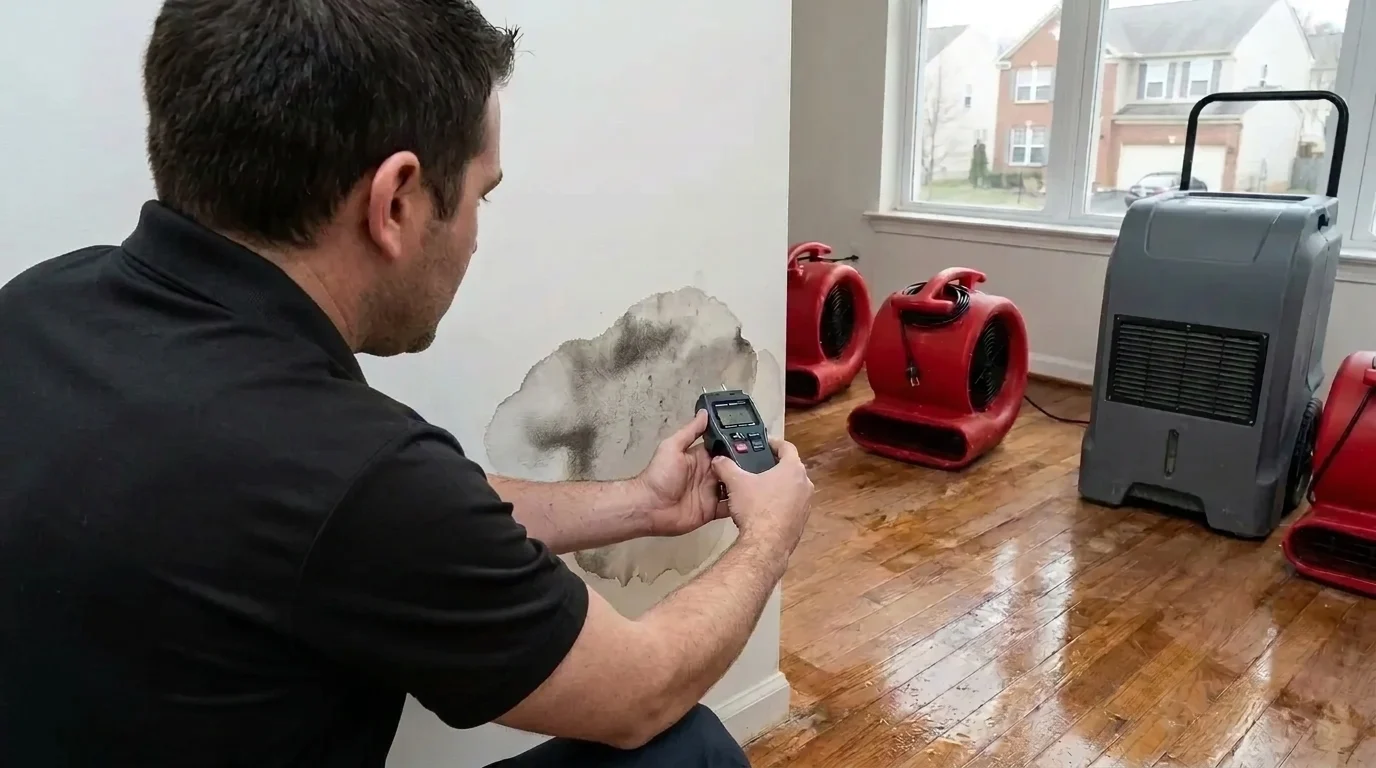
Water damage restoration is the combined work of removing standing water, drying out the structure, and verifying that materials are back to a normal moisture range before anyone closes the walls back up. That means pulling water off floors with truck-mount or portable extractors, pulling up saturated carpet pad (which almost never dries in place), and setting air movers and dehumidifiers positioned to push dry air across wet surfaces rather than just blowing it around the room. Category matters here: clean water from a supply line behaves very differently than gray water from an appliance overflow or black water from sewage backup, and the category determines what materials can be dried versus what has to come out. Drying typically runs several days, with moisture meters checked daily against drywall, subfloor, and framing until readings return to a dry standard, not just “looks dry.”
Our process
- Water extraction. Standing water comes out first, using extraction equipment matched to the volume and surface, carpet, hardwood, tile, or concrete.
- Structural drying setup. Air movers and dehumidifiers get placed based on room geometry and the materials affected, not a flat per-room count.
- Moisture monitoring. Meters and sometimes thermal imaging track hidden moisture in wall cavities and subfloor daily, adjusting equipment as materials dry at different rates.
- Containment for Category 2/3 water. If the water carries contamination, affected porous materials like drywall and insulation are removed and contained rather than dried in place.
- Final verification. Moisture content is confirmed against a dry standard before equipment comes out and the space is cleared for repairs.
What separates a good water damage response from a bad one
The most common mistake is treating every water loss like a carpet-cleaning job: a few fans, a dehumidifier, done in a day. Wood subfloor and double-layer drywall hold moisture far longer than carpet pad, and if the drying stops early because the surface feels dry, trapped moisture behind baseboards and inside wall cavities becomes a mold problem on a two-to-five day clock. A less careful operator also skips documentation, no moisture logs, no photos of affected materials, which becomes a problem if the insurance claim gets questioned later. Adjusters generally want to see daily moisture readings, equipment logs, and clear photos of the loss before and during drying, drying per the IICRC S500 standard rather than a guess at “it feels dry now.” Cutting drying time short to finish faster is one of the most common callbacks in this industry.
What does Water Damage Restoration cost?
Costs vary with the amount of water, how far it traveled, and whether contamination is involved, so every job gets a written scope before work begins rather than a phone estimate. Homeowners insurance typically covers sudden, accidental water damage like a burst pipe or appliance failure, though gradual leaks and flood-related water usually fall outside a standard policy.
Seasonal & regional considerations
Northern Virginia’s freeze-thaw cycles are a recurring cause of winter pipe bursts, especially in crawlspaces and exterior-wall plumbing in older homes around Woodbridge that weren’t insulated to current standards. Summer brings a different pattern: heavy thunderstorms and saturated clay soil that push groundwater against foundations faster than older sump systems can keep up. Either way, the humid Mid-Atlantic air means a wet structure that isn’t actively dried stays at risk for secondary mold growth longer than it would in a drier climate.
Service area
24/7 Restoration Inc. is based in Woodbridge and responds throughout the surrounding Northern Virginia area. Whether the loss is in a Woodbridge townhouse crawlspace or a neighboring community, the same extraction and drying standards apply.
If water is actively spreading through your home or business, schedule your moisture assessment now at (703) 727-0385 and get drying equipment on-site before hidden damage sets in.
Services We Handle
- Flood Cleanup
- Standing Water Removal
- Water Mitigation
- Water Removal
- Wet Carpet Drying
Frequently Asked Questions
Does homeowners insurance cover water damage restoration?
How long does structural drying typically take?
What's the difference between water extraction and structural drying?
Do you have to remove drywall or flooring after a water leak?
What should I do while waiting for a crew to arrive?
Looking for the best emergency water removal/mitigation company in Woodbridge?
24/7 Restoration INC. provides licensed and insured emergency water removal/mitigation in Woodbridge, VA and the surrounding area. Customers rate us 5.0 out of 5 stars across 69 Google reviews. We answer calls 24/7 — call (703) 727-0385 for immediate help.
Need Emergency Water Removal/Mitigation now?
We respond 24/7 across Woodbridge and surrounding VA cities.
Related Coverage
- Our Restoration Services
- Contact 24/7 restoration Inc
- 24/7 Emergency Water Damage Restoration in Alexandria
- 24/7 Emergency Water Damage Restoration in Annandale
- 24/7 Emergency Water Damage Restoration in Arlington
- 24/7 Emergency Water Damage Restoration in Burke
- 24/7 Emergency Water Damage Restoration in Centreville
- 24/7 Emergency Water Damage Restoration in Chantilly
- 24/7 Emergency Water Damage Restoration in Dale City
- 24/7 Emergency Water Damage Restoration in Fairfax
- 24/7 Emergency Water Damage Restoration in Falls Church
- 24/7 Emergency Water Damage Restoration in Fredericksburg
- 24/7 Emergency Water Damage Restoration in Gainesville
- 24/7 Emergency Water Damage Restoration in Herndon
- Burst Pipe Emergency Checklist: Step-by-Step Response
- What To Do in the First 24 Hours After Water Damage
- How To Choose a Restoration Company in Woodbridge (Without Getting Burned)
- The 5 Best Water Damage Restoration Companies in Woodbridge, VA (2026)
- Water Damage Restoration Cost in Woodbridge, VA: What Drives the Price (2026)
- 24/7 Emergency Water Damage Restoration in Potomac Mills
- 24/7 Emergency Water Damage Restoration in Laurel Hill
- 24/7 Emergency Water Damage Restoration in Newington Forest
- 24/7 Emergency Water Damage Restoration in Independent Hill
- 24/7 Emergency Water Damage Restoration in Vienna
- 24/7 Emergency Water Damage Restoration in Buckhall
- 24/7 Emergency Water Damage Restoration in Cherry Hill
- 24/7 Emergency Water Damage Restoration in Linton Hall
- 24/7 Emergency Water Damage Restoration in Dumfries
- Ceiling Water Damage Repair Cost in Woodbridge, VA (2026): From a Stain to a Collapsed Panel
- How Much Does Water Cleanup Cost in VA? (2026 Pricing Guide)
- Mold Remediation in Woodbridge
- 24/7 Emergency Flood Damage Restoration in Woodbridge
- Reconstruction Services in Woodbridge