Lead Paint Abatement in Woodbridge
Lead paint abatement in Woodbridge and surrounding areas. IICRC-certified, insurance billing accepted. Call (703) 727-0385.
A pre-1978 home with peeling or chalking paint isn’t just a cosmetic problem. Lead-based paint was standard in most construction before that year, and once it starts to deteriorate, flake, or get disturbed by a renovation, it sheds dust fine enough to settle into carpet fibers and HVAC systems for months. If you’re planning a window replacement, a kitchen remodel, or you’ve got a toddler putting paint chips in their mouth, the testing and containment steps matter more than almost anything else on the project.
What Lead Paint Abatement actually involves
Abatement is different from a typical paint job in one critical way: the goal isn’t a clean finish, it’s containing and removing a hazardous material without spreading it further. Work starts with testing, either XRF analysis on-site or lab-submitted paint chip samples, to confirm the presence and location of lead. From there, the scope depends on condition: intact lead paint under a stable topcoat may only need encapsulation, while peeling, chalking, or friction-surface paint (windows, doors, stair rails) usually requires removal or full component replacement.
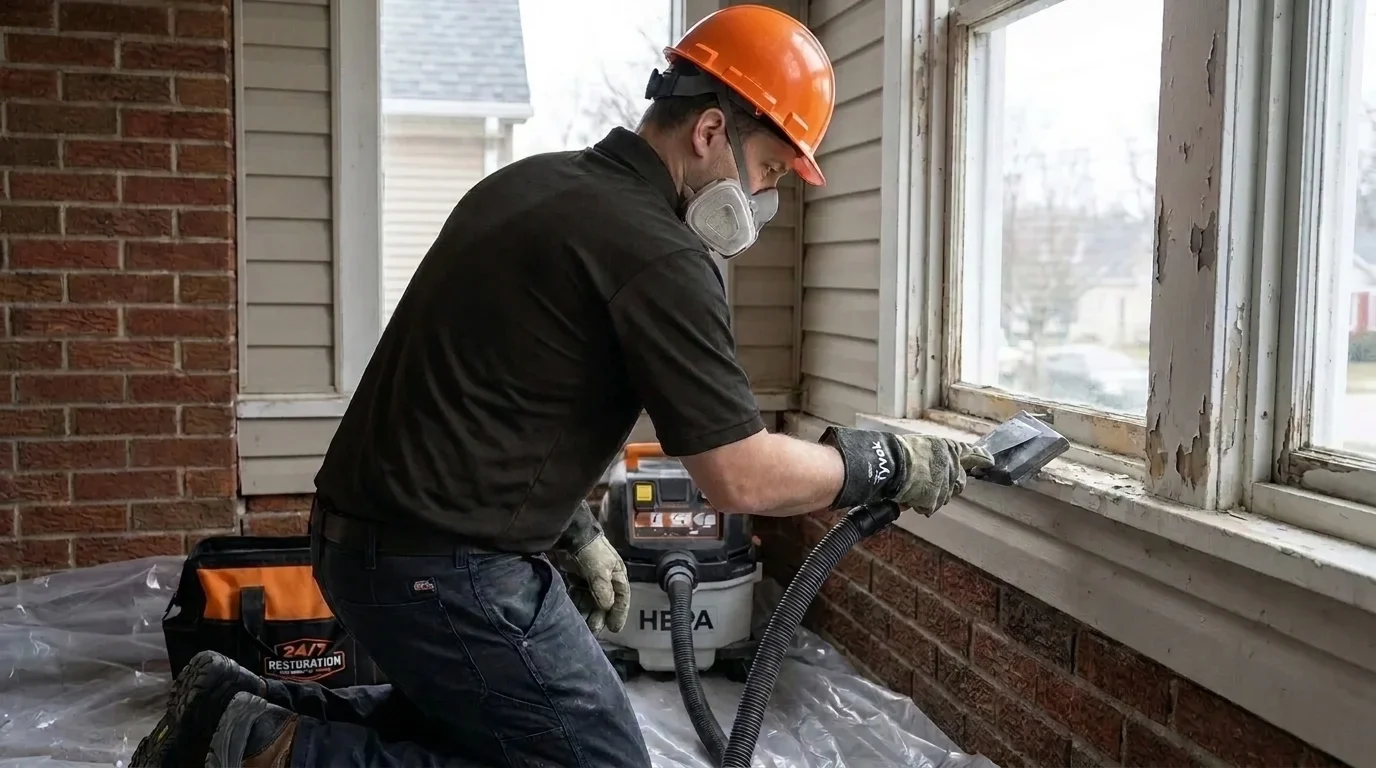
Any home built before 1978 in Woodbridge, Arlington, or the surrounding Northern Virginia neighborhoods we work in is a candidate for this conversation, especially the older brick colonials and post-war ramblers common throughout the region. Work is performed under EPA Lead-Safe certified, RRP-compliant practices: wet methods instead of dry sanding, HEPA-filtered vacuums instead of shop-vacs, and sealed poly containment instead of open work areas. Timelines run from a single day for a room of trim work to a week or more for whole-house exterior abatement.
Our process
- Lead testing and scope confirmation. We identify which surfaces contain lead-based paint and document condition (intact, deteriorating, friction/impact surfaces) before any work plan is finalized.
- Containment setup. Work areas are sealed with poly sheeting, HVAC vents are covered, and negative air or HEPA filtration is set up to keep dust from migrating to the rest of the home.
- Abatement. Depending on the surface, this means wet scraping and HEPA sanding, chemical stripping, full component removal, or encapsulation with a lead-rated coating, always using EPA RRP lead-safe work practices.
- HEPA vacuuming and wet wipe-down. Every surface in the containment zone, floors, sills, and adjacent trim, is cleaned with HEPA equipment and wet methods to capture residual dust.
- Clearance dust-wipe sampling. Surface wipe samples are collected and sent for lab analysis to confirm lead dust levels are below clearance thresholds before containment comes down.
What separates a good lead abatement response from a bad one
The most common failure point is skipping or rushing containment. Dry sanding or scraping lead paint without HEPA capture doesn’t just violate RRP rules, it redistributes lead dust into carpet, ductwork, and soil around the foundation, where it can stay for years. A second common mistake is treating abatement as a one-time paint strip without post-work clearance testing, which means nobody actually confirms the hazard is gone.
Good operators test before quoting a scope, not after work starts, and they document containment setup, waste handling, and clearance results in writing. That documentation also matters if a landlord, buyer’s inspector, or insurance adjuster asks for proof the work was done to standard, since lead abatement records often get requested during a home sale or refinance.
What does Lead Paint Abatement cost?
Costs vary widely based on the number of components involved, whether removal or encapsulation is appropriate, and how much containment the space requires. Every property is different, and 24/7 Restoration INC. provides a written scope of work, including testing results and the specific abatement method, before any work begins. Homeowners insurance typically does not cover routine lead paint abatement unless it’s tied to a covered event like fire or water damage that exposed painted surfaces; renovation-driven abatement is usually an out-of-pocket or seller-disclosure cost.
Seasonal & regional considerations
Spring and summer are when most Woodbridge-area renovation projects start, which is exactly when lead paint on older homes gets disturbed by window swaps, siding work, or deck rebuilds. Humidity also affects encapsulant cure times, so exterior abatement scheduled during Virginia’s humid summer stretch may need extra drying time between coats. Winter abatement work is possible but containment setup takes longer in cold weather since negative air systems have to account for heat loss through sealed openings.
Service area
We perform lead paint testing and abatement work throughout Woodbridge and nearby communities including Arlington, Alexandria, Dale City, Fairfax, Manassas, Springfield, Lorton, Fredericksburg, and surrounding Northern Virginia neighborhoods with older housing stock.
If you’ve got peeling paint on a pre-1978 home, or a renovation that’s about to disturb painted trim, siding, or windows, get the surfaces tested before anyone picks up a scraper. Call (703) 727-0385 to schedule lead paint testing and get a written abatement scope.
Services We Handle
- Asbestos & Lead Abatement
Frequently Asked Questions
How do I know if my home has lead paint that needs abatement?
What's the difference between lead paint encapsulation and removal?
Does homeowners insurance cover lead paint abatement?
Is it safe to stay in the house during lead abatement?
What happens after abatement to confirm the lead hazard is actually gone?
Looking for the best lead abatement company in Woodbridge?
24/7 Restoration INC. provides licensed and insured lead abatement in Woodbridge, VA and the surrounding area. Customers rate us 5.0 out of 5 stars across 69 Google reviews. We answer calls 24/7 — call (703) 727-0385 for immediate help.
Need Lead Abatement now?
We respond 24/7 across Woodbridge and surrounding VA cities.
Related Coverage
- Our Restoration Services
- Contact 24/7 restoration Inc
- Lead Paint Abatement in Alexandria
- Lead Paint Abatement in Fairfax
- Lead Paint Abatement in Falls Church
- Lead Paint Abatement in Fredericksburg
- Lead Paint Abatement in Manassas
- Reconstruction Services in Woodbridge
- Renovations, Remodels and General Contracting in Woodbridge